Influencer Marketing vs. Paid Ads: Two Different Tools, One Budget Fight
Influencer marketing and paid advertising keep ending up on the same budget line, which is where a lot of allocation decisions go sideways. They're not competing versions of the same thing. They work differently, reach people differently, and produce different kinds of value on different timelines.
Treating them as interchangeable, then measuring them against identical metrics, doesn't tell you which one wins. It just tells you which one looks better on the dashboard you built. So the whole thing is kind of distorted.
What paid media is actually built for
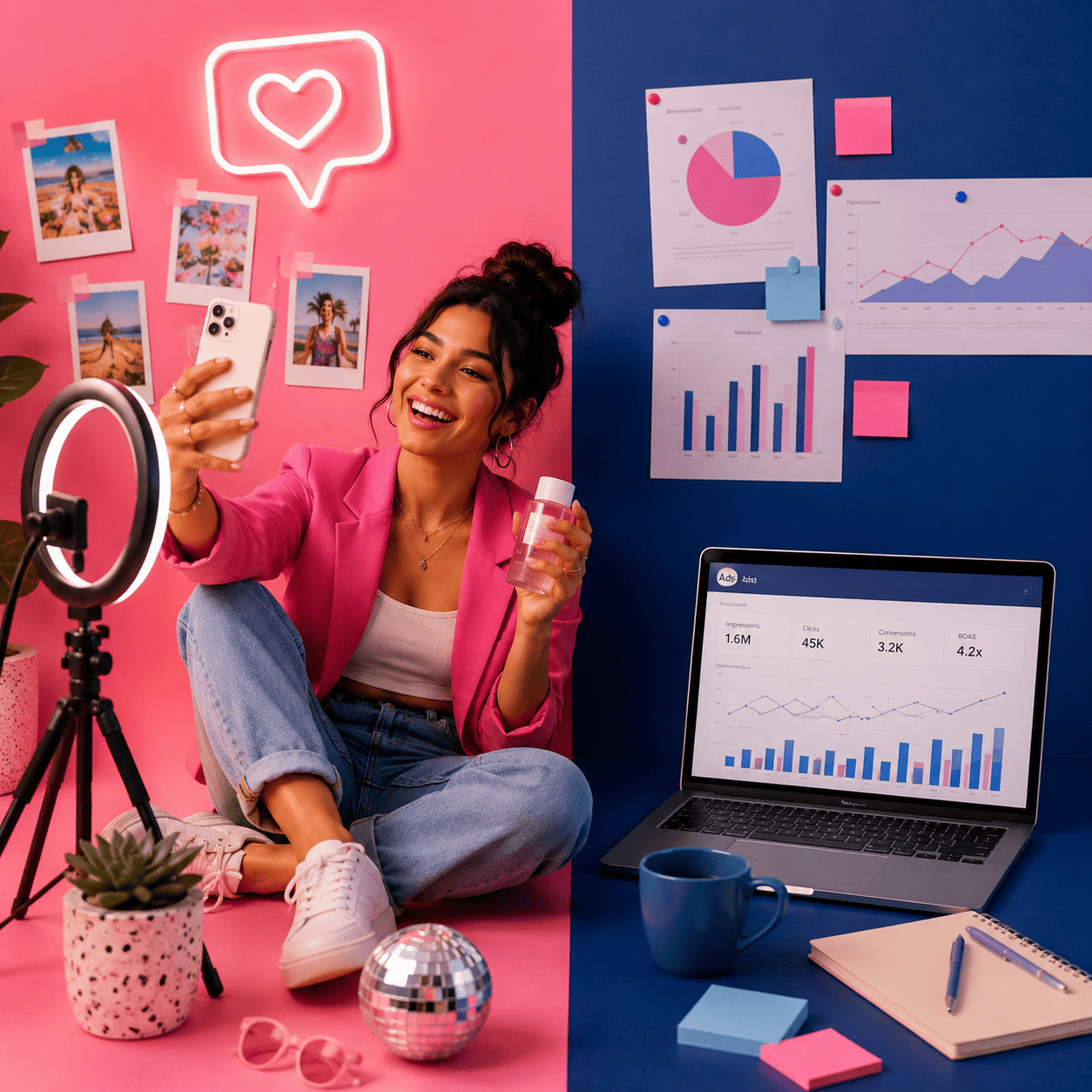
Paid advertising reaches defined audiences fast. Demographics, behaviors, purchase intent: the targeting is precise, the timeline is immediate, and the results are readable. Lookalike audiences, retargeting sequences, mid-flight creative swaps: a well-run paid media operation gives you speed, control, and clean measurement in the same system.
This clarity has been genuinely valuable for so many years. Cost per acquisition, click-through rates, conversion rates: these are numbers finance understands without translation. If you need rapid reach or tight audience control, few channels match it.
But the limits are just as real. Ad costs compound upward across every major platform. Audiences have learned to tune out the volume. The reach stops exactly when the budget does: no residual value, no compounding return. An ad tells the audience you paid to reach them. That works for conversion. It doesn't move credibility.
What creator partnerships are actually built for
Influencer marketing operates on a foundation that paid media cannot recreate: a relationship that the creator established before your campaign existed.
The audience chose to follow that creator and stayed engaged through consistent, resonant content. When a recommendation arrives through that relationship, it isn't processed as a media buy; the audience hears from someone whose judgment they've already decided to trust. You're borrowing that credibility, not the follower count. The trust.
Creators build communities that continue after campaigns close. When you show up consistently through the creators an audience already follows, you earn a place in conversations that existed before the campaign and compound long after it ends. Paid media stops the moment the budget does. Community does not.
Content shelf life matters here. As Instagram integrates with Google search results, influencer content indexed through captions, alt text, and hashtags functions as a searchable asset that extends campaign reach beyond the posting window. The return on a piece of creator content doesn't stop at the campaign close date.
Influencer marketing has a reputation for being expensive. That reputation is not always accurate. 86% of creators are willing to work with brands for free products alone if they love the brand or the product value is high. That's significant when you're running programs at scale or testing a new market without committing a media budget. The cost structure looks very different from paid media when creator content is priced properly.
None of this runs without rigor. Audience alignment, content quality, brand fit, and past performance: all of it requires proper assessment before a brief is written. Measuring ROI requires the right metrics in place from the start, not retrofitted after the campaign wraps.
The measurement problem that keeps coming up
A lot of marketing teams can't tell you clearly what their influencer spend delivered. Every time a campaign wraps and finance asks for the report, the answer is rarely as sharp as it should be. The reason is almost always the same: the measurement framework wasn't built before the campaign started.
Paid ad spend is justified by dashboard clarity. Influencer campaign impact spreads across awareness, trust, and consideration over weeks or months; standard campaign reporting was never built to capture that. 74% of marketers plan to increase influencer marketing budgets in 2026, but most of those programs are going into campaigns without a measurement structure that can actually hold up when finance reviews the line.
Attribution makes it worse. Someone sees a creator post, waits two weeks, searches the brand, and converts through a retargeting ad. The paid ad gets the credit. A viewer walks into a store and buys directly; no tracking link, no data trail. That sale happened because of the content. It just doesn't appear in any report.
Influencer attribution will never be as clean as a click-through. That's not the right benchmark. The bigger problem is briefing for one outcome and reporting on another. Define what the campaign owes the business before you brief a single creator. Then measure that. Finance won't fund what it can't audit; building the measurement framework up front is the structural shift that turns influencer spend from a discretionary line item into a defensible one.
The case for sequencing both channels
The marketers seeing the strongest results aren't choosing between paid media and creator partnerships. They're sequencing them. Creators build trust and generate authentic content; paid media amplifies that content to broader audiences and retargets the warm audiences that the creator activity built.
77% of marketers actively repurpose creator content in paid ads. UGC ads generate 4x higher click-through rates and 50% lower cost-per-click than standard brand creative. The compounding effect of combining both channels is measurable.
Two routes exist for running creator content as paid media. Whitelisting grants the brand advertising permissions on the creator's account, allowing ads to run from the creator's handle on Meta or TikTok; because the content originates from a creator, it reads as organic in the feed. The second route runs creator content from the brand's own profile: repurposing influencer posts that already performed organically, or commissioning UGC made specifically to run as ads.
Most people miss the usage rights step. Paying for a post or gifting a product does not transfer content ownership. Usage rights are separate from campaign fees and need to be negotiated upfront. Partnerships that include clear licensing terms from the brief stage define what you can use, for how long, and on which channels. Without that, repurposing creator content for paid ads can lead to disputes after the campaign has already closed.
What actually changes when you frame it differently
Paid media scales fast, measures cleanly, and stops when the budget does. Creator partnerships build trust that media buying can't replicate, generate content with a shelf life beyond the campaign, and reach audiences through a voice they chose to follow.
Different tools, different jobs. Reframe the budget conversation around what each channel is actually built to do, and both start pulling in the same direction instead of competing for the same line.
beyondINFLUENCE works with brands building creator programs that hold up to finance-level scrutiny, from brief to measurement. If you're rethinking how your channels should work together, that's a conversation worth having.
-
It's not an either/or question. What you're trying to achieve determines how you use each one. Paid ads are built for speed and precision. Influencer marketing is built for trust and content that keeps working after the campaign ends. Most brands use both, sequenced intentionally so each channel feeds the other.
-
Whitelisting means a creator grants your brand advertising permissions on their account. You run paid ads from their handle on Meta or TikTok rather than your own. The content looks and feels organic in the feed because it comes from a real person, not a brand account. Audiences process it differently. That's why whitelisted content regularly outperforms standard brand creative on click-through rates and cost-per-click.
-
Yes, and it's a separate conversation from the campaign fee. Whatever the collaboration structure, usage rights need to be negotiated upfront, not assumed.
-
Often more effectively than brands with larger ones. Bigger budgets pull toward macro creators: broad reach, thinner audience relationships, higher costs. Smaller brands can go deeper at the nano and micro tier, where community trust is tighter and brand fit is harder to fake. 86% of creators are willing to work with brands for product alone if the fit is genuine. That's not a loophole. That's what good creator matching actually looks like in practice.