Google Search Console Now Measures Creator Content
Creator content has been showing up in Google Search for years. Brands and creators both knew. Nobody could measure what happened next, so we all just moved on, including me.
Google just took that excuse away with a recent update to Search Console.
What did Google's Search Console update actually change?
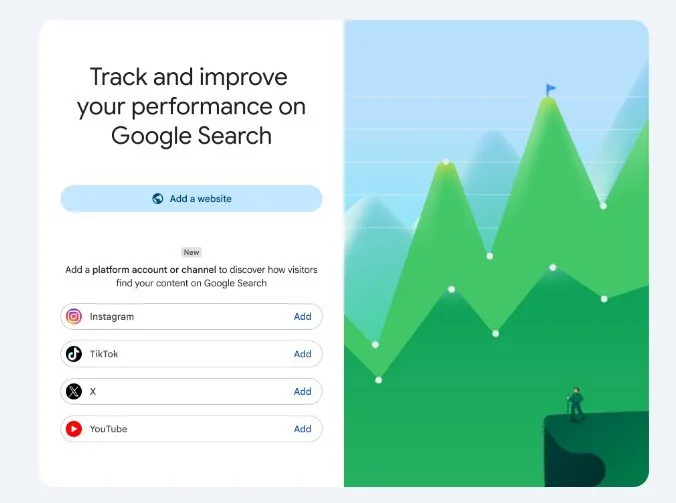
Search Console has always required a verified website: a domain you own, with a DNS record to prove it. That changed when Google introduced social media platform properties. Instead of verifying a website, brands and creators can now connect their social accounts and access Search performance data showing how content from those accounts performs in Google Search and Discover, including clicks, impressions, and search queries.
Once verified, you get 3 reports:
Performance shows total clicks, impressions, and additional metrics, filterable by post and by query.
Insights gives a rolling view of traffic trends and top-performing content, along with how people are finding the account through Google.
Achievements track growth milestones, like crossing a new click threshold over a 28-day window.
Per Google's announcement, creators and publishers now reach audiences well beyond their own website. It took Google this long to say the obvious part out loud.
The feature is being rolled out gradually, so it may not show up in every account yet.
It’s worth separating this update from Search profiles, which launched in June. A Search profile is public-facing: a page a qualifying creator can build to showcase their work directly in search results, open only to creators who meet Google's follower and eligibility criteria (a hefty bar: 100,000 followers on YouTube, Instagram, or X, 300,000 on TikTok, plus a minimum age of 18 and a US account). A platform property is the opposite. It's internal analytics, visible only to the account owner unless they choose to share that access or data with someone else.
How to Connect Your Social Accounts to Google Search Console
Setting it up takes a few minutes. Here's how to do it:
Open Search Console.
Go to Search Console verification page or or open the property selector drop-down anywhere in Search Console
Click "Add property."
Choose a platform. You can choose Instagram, TikTok, X, or YouTube.
Follow the onscreen steps. These steps will ask you to sign in and confirm the connection.
Wait for the data. Data can take up to 48 hours to appear after you connect the account.
Why does this matter for influencer marketing?
Social accounts are finally getting the same treatment as websites in Google's eyes. Creators can see which search terms bring people to their social accounts, how often that content surfaces in Search, and what people do once they land on it.
Until now, the value of creator content was only measured through social media analytics like reach and impressions. What happened after someone typed a query into Google and found a piece of creator content weeks or months later was completely invisible.
A creator pitching a brand can say a skincare routine reel got 40,000 views on Instagram. They can now also say it picked up 100 clicks and 50,000 impressions in Google Search over the following 2 months simply because someone typed "best skincare routine for oily skin" and that same reel showed up in the search results.
Creators have been generating that kind of value for years. For the first time, they have a way to measure it.
What should brands do with this information right now?
First, verify any social accounts the brand owns directly. That's what starts the data collection and gives a brand its own first-party view of how its own content gets discovered.
Next, use that data when planning creator campaigns. If Search Console shows people regularly searching "how to layer skincare products," that tells the creator exactly what to make before they hit record. The creator is making content for two audiences: the people who see it live, and the people who find it in a Google search six months later.
For creator partnerships, none of this comes automatically. Brands don't get search performance data on creator-owned accounts unless the creator agrees to share it. But it changes what a brand can ask for.
Instead of a screenshot of an Instagram engagement rate, a brand can ask for a creator's past post performance in Google Search and Discover. Platform metrics only show half the picture. Search performance shows the other half.
How this update fits into campaign reporting isn't settled yet. Brands should know this much: a reel they paid a creator for 2 months ago now has measurable search data attached to it. A campaign that looked finished after 30 days could still be earning search impressions and clicks weeks or months later.
What Does This Mean for Influencer Marketing Long-Term?
Creator content has been treated as something that lives and dies inside a social platform, with its value tied to likes, shares, and whatever engagement came with it. With this move, Google made it clear that creator content is a search asset now, and the platform it was posted on is no longer the only place its impact gets measured.
A creator can point to search performance alongside likes and comments, proof the work kept reaching people past the campaign's active run.
Platform properties is Google's second creator-specific feature this year, after Search profiles in June. Two features in two months isn't a coincidence, and with the launch of the new Google for Creators Instagram account, I'd bet there's more coming.
Creators have been contributing to search for years. Google finally gave them a way to measure it. About time.