Partnership ads, the Meta format that runs a brand's ad from a creator's handle, grew more than 97% year over year and passed a $15 billion annual revenue run rate. Let that sink in for a moment. That's ad money spent only on campaigns run with creators, and Meta reported it on its Q3 earnings call in October.
The IAB says US brands will spend $43.9 billion on creators this year, and about 55% of that is paid media behind creator content.
We run partnership ads for clients every week at beyondINFLUENCE. When something goes wrong, it's usually because the creator contract didn't cover paid usage.
Running a creator's post as an ad needs the creator's permission, and you have to write that into the contract and pay for it separately. Do it for every creator before the post goes live, and it costs a lot less than asking after the Reel takes off.
Not sure whether your creator contracts cover paid amplification? The Influencer Marketing Health Check reviews your ad rights clauses with you.
What are partnership ads, and how do they differ from whitelisting and Spark Ads?
Partnership ads run creator content as an ad from the creator's own handle. TikTok calls them Spark Ads. Whitelisting is the permission behind both.
The brand pays for the media and controls targeting, budget and delivery from its own ad account.
Whitelisting also goes by allowlisting, and people use all three terms interchangeably in meetings even though they mean different things.
I have Ads Manager open most weeks with a stack of ads delivering from creators' handles, with our budget and targeting behind them. Every one needed the creator's permission first, written into the contract and priced separately.
"But we paid the influencer."
You did. You paid them to create the content and post it. Advertising from their account for the next 6 months is a separate permission, and they're well within their rights to charge for it.
An ad built on a published post keeps the likes, comments and shares it earned organically, so people see straight away that others liked it.
You can also run content from a creator's handle that never appears on their feed. These dark posts let you test 12 versions of a message without filling up the creator's profile with ads.
Why are brands moving media budget into creator-led ads?
When you put ad money behind creator content, you get the same targeting, pixel tracking and CPA reporting as with every other paid social ad.
Organic posts give you data too, but you get it as screenshots or exports, every platform counts differently, and you can't track what people do after they leave the app.
For a lot of brands, this started as a reporting decision. The numbers finally came back in a format the finance team understands.
Some brands have genuinely solved attribution, and they talk about creator spend with a lot more confidence. For everyone else, the numbers still come from the platform itself, and running the ad from a creator's handle doesn't change that.
The bigger win is the content itself. A creator post that already worked organically usually performs better than anything a studio builds from scratch.
We used to put ad money only behind the posts that did well on their own. Today it's planned from the start. Olivia Cripps, global paid media director at Billion Dollar Boy, told Digiday in May that two global retail clients had raised their amplification budgets by 79% and 253% within a year.
Creator content is also much cheaper than a studio shoot, and you get a lot more of it. That matters, because paid social uses up creative faster than any agency can produce it.
In Q3, Meta finished rolling out its Creator Marketing Hub to all advertisers, putting more than 10 million creators and partnership ad activation in one place.
At Advertising Week in October, TikTok introduced Smart+ Creative Selection. It puts creator content into one approval queue alongside an advertiser's own assets and AI-generated video from its Symphony suite.
If I put myself in the creator's shoes, their video is now just one option next to an AI-generated one. I don't love it.
Do partnership ads perform better than ads from the brand's own account?
On Meta, yes. Agentio's analysis of $130M in spend found 19% higher CTR, 10% higher conversion and 5% lower CPA versus licensed UGC.
The dataset covered 65,000 ads from 137 brands and compared ads carrying the creator's handle with licensed creator content run from the brand's own account.
Those ads also cost 19% more per thousand impressions, so don't let anyone promise you cheaper media.
The gap is widest in Search placements, where conversion rate was 143% higher and CPA was 63% lower. Stories went the other way: click-through rose 11%, but CPA came in 25% worse.
A creator-led ad shows up with the creator's name, photo and existing post, and that's why it feels less like an ad.
Brand-account ads give you more control over the creative and suit campaigns about a product feature or a sale. Most brands run both, which makes sense.
How do you get permission to run ads from a creator's handle?
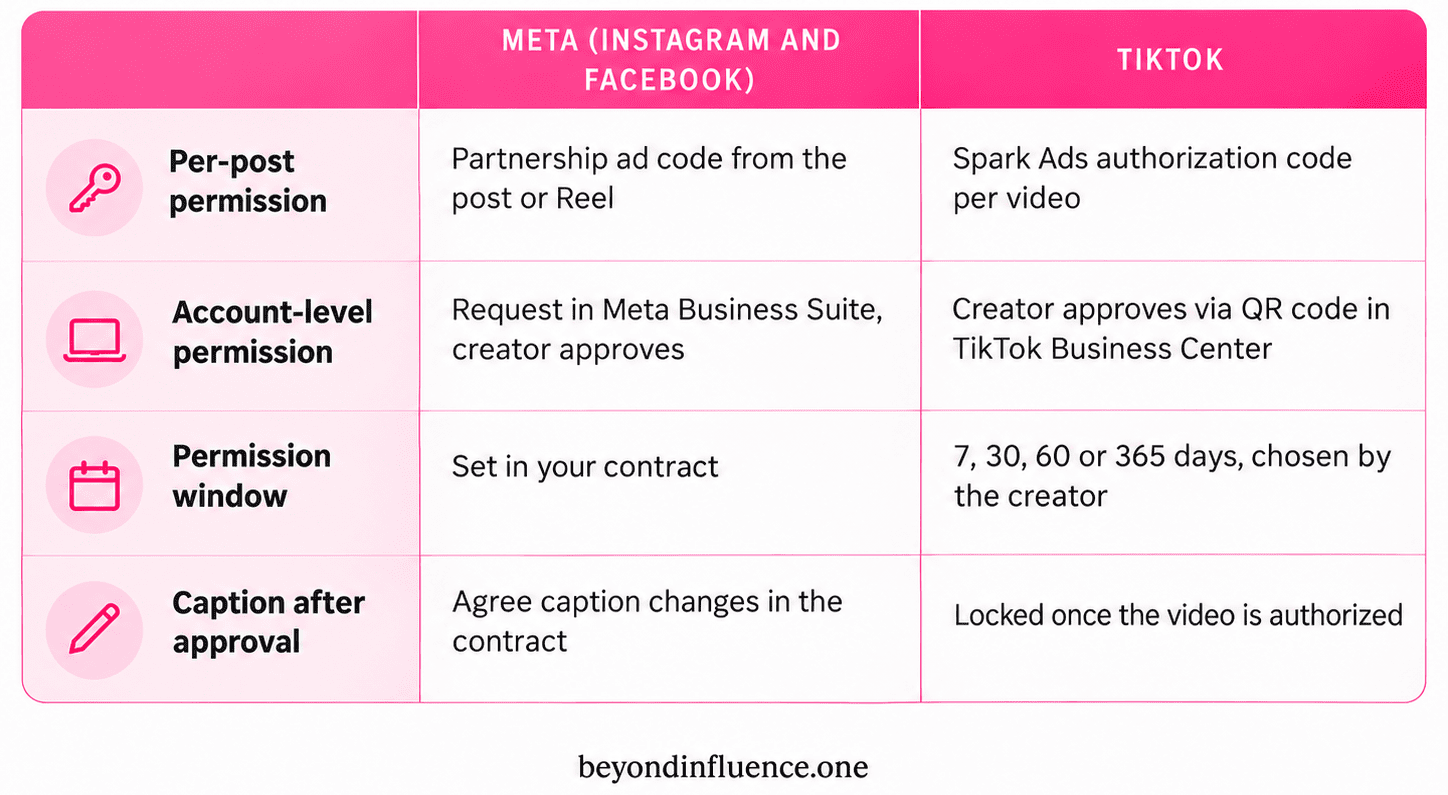
Meta uses a per-post partnership ad code or account-level access in Business Suite. TikTok uses Spark Ads codes or account access in Business Center.
Meta (Instagram and Facebook)
For a single piece of content, the partnership ad code is the most common route, and it's how we usually do it at beyondINFLUENCE. The creator opens the post or Reel, taps "Partnership label and ads," turns on "Get partnership ad code," and sends it over. We paste it into Ads Manager and set budget, targeting and objective.
Account-level access is worth setting up properly. You send a request in Meta Business Suite under Settings, then Ad partnerships, the creator approves, and you can build partnership ads from their handle without chasing a new code each time.
Account-level permission also lets you include or exclude the creator's own followers. Excluding them stops you paying to reach people who already saw the post for free, and I'd guess 9 out of 10 programs never switch it on.
TikTok
On TikTok, the standard route is the Spark Ads authorization code. The creator opens the post, goes to Ad settings, turns on ad authorization, picks a window of 7, 30, 60 or 365 days, and generates a code.
Every video needs its own code, and the caption locks once the post is authorized. Whatever the creator wrote is what your ad says for the whole window.
Account-level access goes through TikTok Business Center, where the creator scans a QR code to approve it, either for their existing posts or for publishing new videos through their account.
Also worth knowing: a private video becomes public once it's used in a campaign, and the creator can't change the privacy setting while the ad is live.
How long does a creator-led ad keep working?
About 36 days. Agentio found winning partnership ads start to fatigue after 36 days of spend, and CPA rises 1.8x on average after that.
Now put that next to the hit rate. Across 8,696 purchase-objective ads from 56 brands, the median hit rate was 20.4%.
That means only one ad in five works, and the ones that work last about 5 weeks. If you want amplification to work as a channel, you need a constant supply of creator content and the right to advertise with it for longer.
A 30-day TikTok authorization runs out right when the ad starts to fatigue. And 7 days isn't even enough to know if the ad works: at $100 of spend, 45% of the ads that end up winning still look like losers.
The brands that have this sorted run 365-day windows as standard and keep cleared content from several creators ready for every concept. If you're still buying permission one post at a time, that's usually why the channel stalls in month 2.
Which creator posts can't be turned into ads?
Posts built on trending sounds or popular songs often can't run as ads, because the creator's right to the audio doesn't cover paid media.
On Instagram and Facebook, Reels with copyrighted music may not be eligible to run as ads. TikTok applies the same logic through its Commercial Music Library, and rights holders pay a lot more attention once spend scales.
The post that performed best organically is often the one you can't amplify, because the sound is what made it work. Nothing like finding that out on day 3 of a launch.
Put commercially cleared audio into the creative direction from the start, right next to the ad rights clause.
If the original sound can't be used, you may still run the video from the brand's own account with different audio, provided your usage rights cover editing and paid media. That's much easier than asking a creator to remake their best video with worse music.
Does "Bezahlte Partnerschaft" cover you in Germany?
No. Germany's Medienanstalten say platform labels alone aren't enough. Write "Werbung" or "Anzeige" at the start of the post.
The Medienanstalten are direct about this, and the German word has to be legible at the start of the post. English terms like "ad" or "sponsored by" don't qualify on a German-language account, and the platform label can go on top as an extra.
TikTok locks the caption at authorization, so the labeling has to be right before the code exists. Whatever the caption says stays in your ad until the authorization ends.
So, if you're advertising in Germany and your compliance check happens at the ad stage, you're too late. That's the first thing I'd fix.
What do creator ad rights cost?
There's no fixed rate. Creators commonly charge 15% to 35% of their base fee per 30 days of paid usage, and some agencies take 3% to 10% of media.
The fee range comes from Aspire's 2026 research, and the media-budget range from a Wasserman executive quoted by Digiday in January.
The longer the window, the more it costs. Exclusivity, more markets and more formats add to the price.
Aspire also found that 77% of brands repurpose creator content in paid ads, and 67% build paid usage into the creator's initial contract or rate. That second number should be much closer to the first.
What do you budget, then? Work it out as a percentage on top of the content fee and set it at contract stage, while you still don't know which post will be the one.
It gets expensive when you wait until the post performs and then ask. By then the creator has seen the numbers too, and prices the permission accordingly.
We have all asked for ad rights after the fact at some point, including me.
What should a creator contract cover before you run partnership ads?
The ad rights clause should set the permission window, markets, formats, caption and audio rules, German labeling and renewal terms upfront.
Negotiate it for every creator before anyone knows which post will win, so the paid team can move the moment the data comes in. Cover:
The authorization window, matched to how long winning ads actually run
Markets and formats, including whether dark posts are allowed
Whether you can edit the caption or swap the audio
Commercially cleared music in the creative direction
"Werbung" or "Anzeige" at the start of the caption for German-language posts
How the permission gets renewed or ended, and at what price
Keep an eye on the window length over the next 2 years. Most deals still default to 30 days of paid usage, set when amplification was the smaller share of creator spend, and creators have started arguing it should move.
If you'd like a second pair of eyes on the clauses you already have, that's what the Influencer Marketing Health Check is for.
Let's influence.