Is YouTube Making Creators Work Harder for Their Money?
YouTube says it wants to reward active creators and open up more ways to make money across the platform. At the same time, it's made monetization harder to reach, changed what counts as a view, added pressure on Shorts creators, and reportedly offered millions to keep its biggest names off Netflix.
So which is it? Rewarding creators, or making creators work harder while the platform gets more valuable to brands? Here are my two cents.
Monetization changes that have ruffled some feathers
YouTube has recently announced a handful of changes to its monetization programs, and short story short, creators are pissed.
The entry bar for YouTube's ad revenue program has doubled
YouTube wants YPP (Youtube Partner Program) to remain the leader in the creator economy. Its solution: make the program harder to get into.
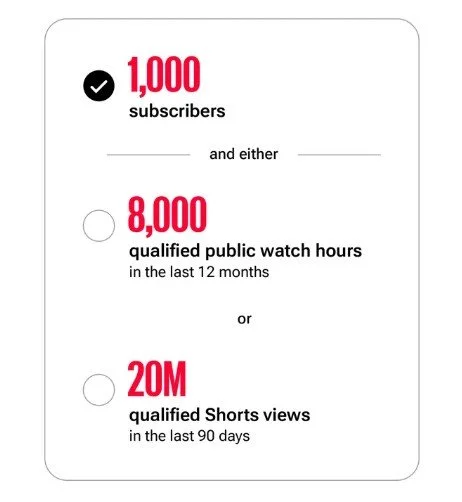
Right now, joining the YouTube Partner Program (YPP) for ad and Premium revenue sharing takes 1,000 subscribers and either 4,000 watch hours in the last 12 months or 10 million qualified Shorts views in the last 90 days. Starting February 1, 2027, that becomes 1,000 subscribers and either 8,000 watch hours in the last 365 days or 20 million qualified Shorts views in the last 90 days. Channels already accepted into the YPP are not affected and don't need to hit the new numbers to stay in. Channels not yet in can still qualify under today's lower requirements but only if they get there before February 1, 2027.
YouTube now sees over 200 billion daily Shorts views and more than a billion daily watch hours on TV screens, and it says the threshold needs to keep pace with that growth.
Some smaller creators have called the change a slap in the face. YouTube VP of Creator Product Amjad Hanif's response: higher watch time requirements mean higher payouts. His reasoning is that raising the bar helps creators earn real income from their YouTube work, instead of a few cents a month.
So if you're not earning real money, you don't earn anything at all. Right?
The expansion of Premium Lite
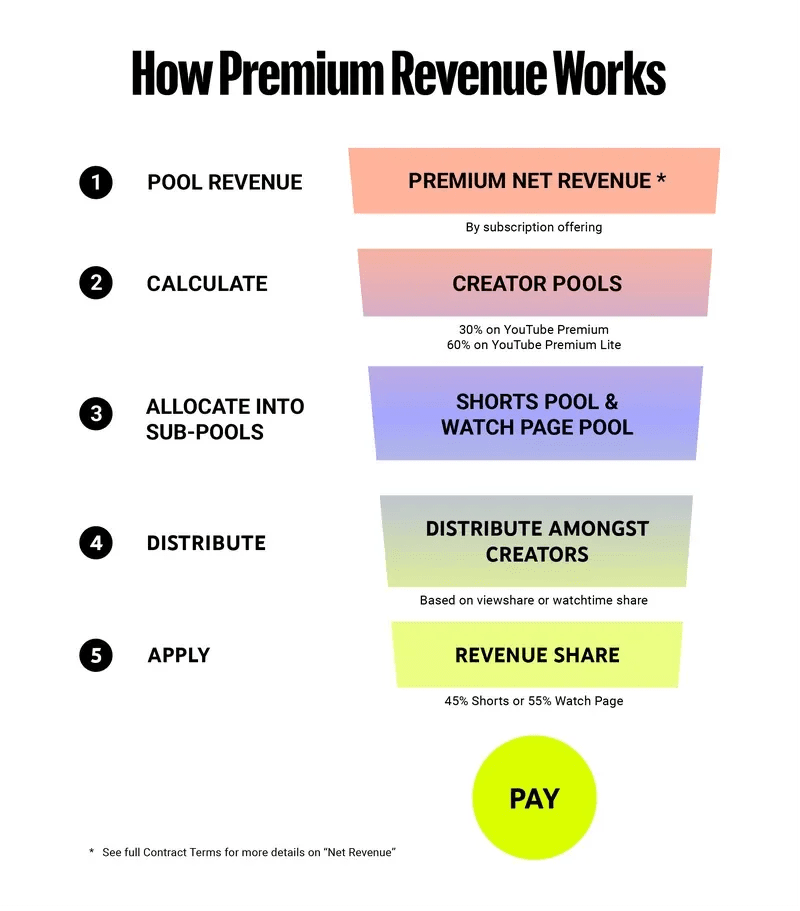
Premium Lite is YouTube's cheaper Premium tier, ad-reduced rather than ad-free, and it's now rolling out everywhere Premium exists. For creators already in YPP, that means a larger pool of Premium subscribers who can contribute to subscription revenue instead of ad revenue. YouTube says partners earn more, on average, from a Premium viewer than from an ad-supported one, based on 2026 performance.
YouTube raised the bar in one part of its monetization system while expanding another pool of money creators can tap into.
Shorts Update
Starting February 1, 2027, creators need 10 million qualified Shorts views over the last 90 days to be eligible for ads and YouTube Premium revenue share from the Shorts Creator Pool. The tricky part here is that this isn’t a requirement you hit once and then you're in the clear. The 10 million views have to be maintained on a rolling 90-day basis.
Channels below the threshold remain in YPP and continue earning on long-form content, with Shorts revenue sharing resuming automatically once they cross 10 million qualified Shorts views again.
New Shorts Incentive Programs
Creators who post Shorts but fall below the 10 million qualified-view threshold will get access to new incentive programs designed to create more ways to earn beyond ad revenue, including bonuses for YouTube Shopping, incentives for brand deals, and earnings boosts for starting and growing trends. YouTube hasn't shared the mechanics yet.
What’s staying the same
Fan funding (Super Chats, channel memberships), YouTube Creator Partnerships, and YouTube Shopping see no eligibility changes. Additional YPP update (yes, there’s more to it)Separately, creators who are considered inactive get a 90-day window to requalify at a lower bar: 1,000 watch hours in the last 365 days or 1 million Shorts views in the last 90 days.
One more deadline
One more date matters here. Creators who don't accept YouTube's updated terms by January 31, 2027, stop earning from the monetization features tied to those terms starting February 1.
YouTube is also redefining what counts as a view
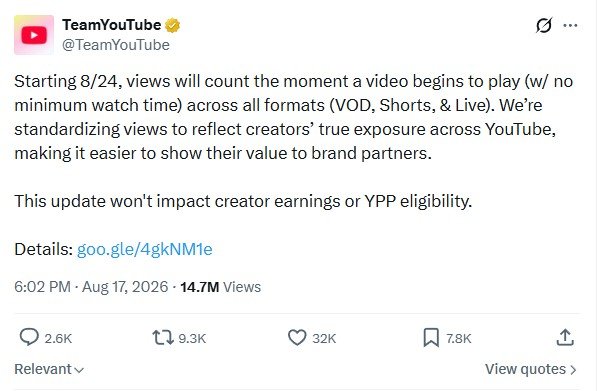
Since August 24,a view counts the moment a video starts playing, with no minimum watch time, across VOD (video on demand), Shorts, and live.
Until now, counting views by minimum watch time is what separated YouTube from other platforms. Take that away and views become a way less useful metric, but a lot easier for creators to flash at brand partners: “look how many views I got.”
On the surface, this brings YouTube closer to the way TikTok and Instagram count views, making it easier for brands to compare apples to apples. This is fine, but if they keep defaulting to this simplified public number when they judge a creator's performance, that's where it becomes a problem.
The silver lining in all of this: The numbers displayed on a video are now easier to inflate, yes. But YPP earnings are still calculated on engaged views and engaged watch hours, and eligibility still comes down to qualified views. Almost like YouTube is saying that views don't tell the whole story. I’ll pretend like I haven’t been saying that for years now.
What does this mean for creators?
A lot of creators aren’t happy about these changes, and they do not believe YouTube's good intentions even a little. Here’s who wins, who gets squeezed, and what it means for everyone else.
Long-form Creators
Established creators already in YPP come away without a scratch. Unlike short-form creators, they don't have to chase the new 10-million-Shorts-views threshold or a recurring 90-day target to keep earning from the audience they've already built.
Long-form creators not yet in YPP face a higher bar to qualify for monetization. The increased watch-hour requirement makes it harder to reach monetization in the first place, but unlike the Shorts threshold, creators only need to meet the watch-hour requirement only once.
Short-form creators get the short end of the stick. Ad revenue and YouTube Premium revenue sharing for Shorts now require 10 million views on a rolling 90-day basis. Crossing the threshold once doesn't keep a Shorts creator monetized. They have to keep hitting it, turning Shorts monetization into a constant consistency game. A slow stretch or a few weeks of lower performance can put a creator back outside the threshold.
YouTube says Shorts creators, including those below the 10-million mark, will “benefit” from new targeted incentive programs aimed at diversifying their income. That includes YouTube Shopping bonuses, incentives for brand deals, and earnings boosts for creators who start or grow trends.Smaller creators are getting pushed toward diversification, whether they asked for it or not: long-form content, memberships, affiliate commerce, Shopping. Fan funding and Shopping stay accessible at lower thresholds, and YouTube says that's meant to help creators start earning sooner. The problem is that the path to what YouTube itself calls 'meaningful' ad revenue gets substantially longer.
And then there are infamous “AI slop” channels. These can rack up huge-looking view counts under the new rules, but that doesn't mean their content is suddenly easier to monetize. AI slop can look wildly successful on the surface while still failing to clear the metrics that determine whether a creator gets paid.
And what about brands in all of this? They get a deeper pool of creators pushed toward commercial activity. The catch brands should pay attention to, though, is that the public view count tells them less about actual creator performance than it used to. If they start treating it as the primary measure of creator value, they could end up making decisions based on a number that looks more impressive than it is.
Where is YouTube Going with All This, Really?
For years, YouTube monetization has been closely associated with ad revenue. Now, it’s making it harder for new creators to access ad and Premium revenue sharing while adding more ways for eligible creators to earn, including Shopping, brand-deal incentives, trend-based incentives and Premium Lite. It also says it expects to pay creators more in 2027 than it did in 2026. But getting a piece of that money may look very different from what it has looked like so far.
More ways to make money sound great. Congratulations, I guess. But every new revenue stream comes with another list of things to manage: finding brand deals, selling products, building memberships, managing partnerships. Making the content is still the job. There's just a lot more business around it now.And nowAmazon is joining the party, at least for U.S. creators. YouTube added Amazon to its Shopping Affiliate Program, letting eligible creators tag Amazon products directly in long-form videos, Shorts, and livestreams and earn commissions from the resulting sales. Instead of sending viewers to an affiliate link in the description, creators can put the product in front of them directly through YouTube Shopping.
YouTube says the feature is already proving more effective. In a July experiment, videos using Shopping product tags generated 110% more product clicks than videos using description links alone.
For anyone who has been paying attention to the creator economy, none of this is exactly a surprise. Creators have been diversifying their income and building businesses around their audiences for years. The idea that a creator is simply someone who makes content and generates views is already outdated.
And when creators are businesses in their own right, rather than people with a follower or subscriber count attached, it makes sense that other platforms would want a piece of that business too.
The Bidding War with Netflix
YouTube is reportedly offering select creators millions to keep content exclusive, as Netflix expands its push into creator-led video. Bloomberg reports the proposed arrangements would give creators financial incentives, direct financing for specific programs, and a cut of major brand deal revenue, to keep their content on YouTube exclusively for a set period.
Netflix is going after some of YouTube's biggest names directly, paying to put their content on its own platform. The fact that YouTube is willing to spend millions to prevent that says something about where the power sits right now. Here is how I see it: creators have become an asset platforms compete for.
YouTube's biggest stars are worth enough to attract competing offers. And honestly? Good for them. If YouTube really is spending millions to keep its biggest stars at home, the creator economy may be entering a bidding war of its own.
Which is it?
So, rewarded or working harder? Probably both, depending on the creator.
Long-form creators already inside YPP keep what they built. Everyone else is chasing a higher bar to get in, and Shorts creators now have to keep clearing that bar every 90 days to stay eligible. At the same time, there are more ways to get paid outside of ads: Premium Lite, Shopping bonuses, brand-deal incentives, memberships.
At the top of that same system, the biggest creators have built businesses substantial enough that YouTube and Netflix are willing to spend real money fighting over them.
Not a single boring day in the creator economy.
Frequently Asked Questions
-
February 1, 2027. Channels already in the YouTube Partner Program keep their current status. Channels not yet in need to hit the new thresholds if they qualify after that date.
-
1,000 subscribers and either 8,000 watch hours in the last 365 days or 20 million qualified Shorts views in the last 90 days. That's double the current watch-hour requirement.
-
No. The 10 million qualified views have to be maintained on a rolling 90-day basis. If a creator drops below the threshold, Shorts revenue sharing pauses until they cross it again.
-
No. A view now counts the moment a video starts playing, with no minimum watch time. YPP earnings still run on engaged views and engaged watch hours, and eligibility still comes down to qualified views.
-
Not confirmed. Bloomberg reported that YouTube is offering select creators financial incentives to keep their content exclusive to YouTube, including direct financing for programs and a share of revenue from major brand deals, as Netflix expands its push into creator-led content.