The Old Way of Influencer Marketing Isn't Enough Anymore
I keep seeing headlines asking if influencer marketing is dead, or if the era is over, and every time, I have to laugh a little. In a way, it is. The version where a creator sounds like a person until the brand deal shows up is on its way out.
Being an influencer in 2026 isn't the same job it was 10 years ago. This one here is for brands: Keep running your campaigns the way you did five years ago, and you'll spend your budget on content your audience has already learned to scroll past.
What audiences tolerate from creators now
Audiences have become more selective about the content they give their attention to. 73% of social media users say creator lifestyles feel unrealistic, 71% have unfollowed a creator because they stopped feeling relatable, and 58% say they get bored and move on to someone new.
(Source: Mintel research, as cited by Vogue Business)
That doesn't mean people have suddenly started founding "I hate influencers" clubs. They still follow creators, buy things they recommend, and want to hear what they think, as long as the content still feels real and is worth their time. You can't expect a creator to make something feel genuine when the collaboration is treated as a simple content order. If the entire collaboration is essentially "here's the product, here's what we need you to say, here's your deadline," the creator has very little room to make it their own. Their content will reflect exactly that, and you'll be left thinking influencer marketing might be a scam after all.
If audiences are becoming more selective about what they give their attention to, choosing the right creator in the first place matters more than ever.
You can't answer 'which creator' until you know what the campaign needs to do and learn about the creator’s “underbelly”
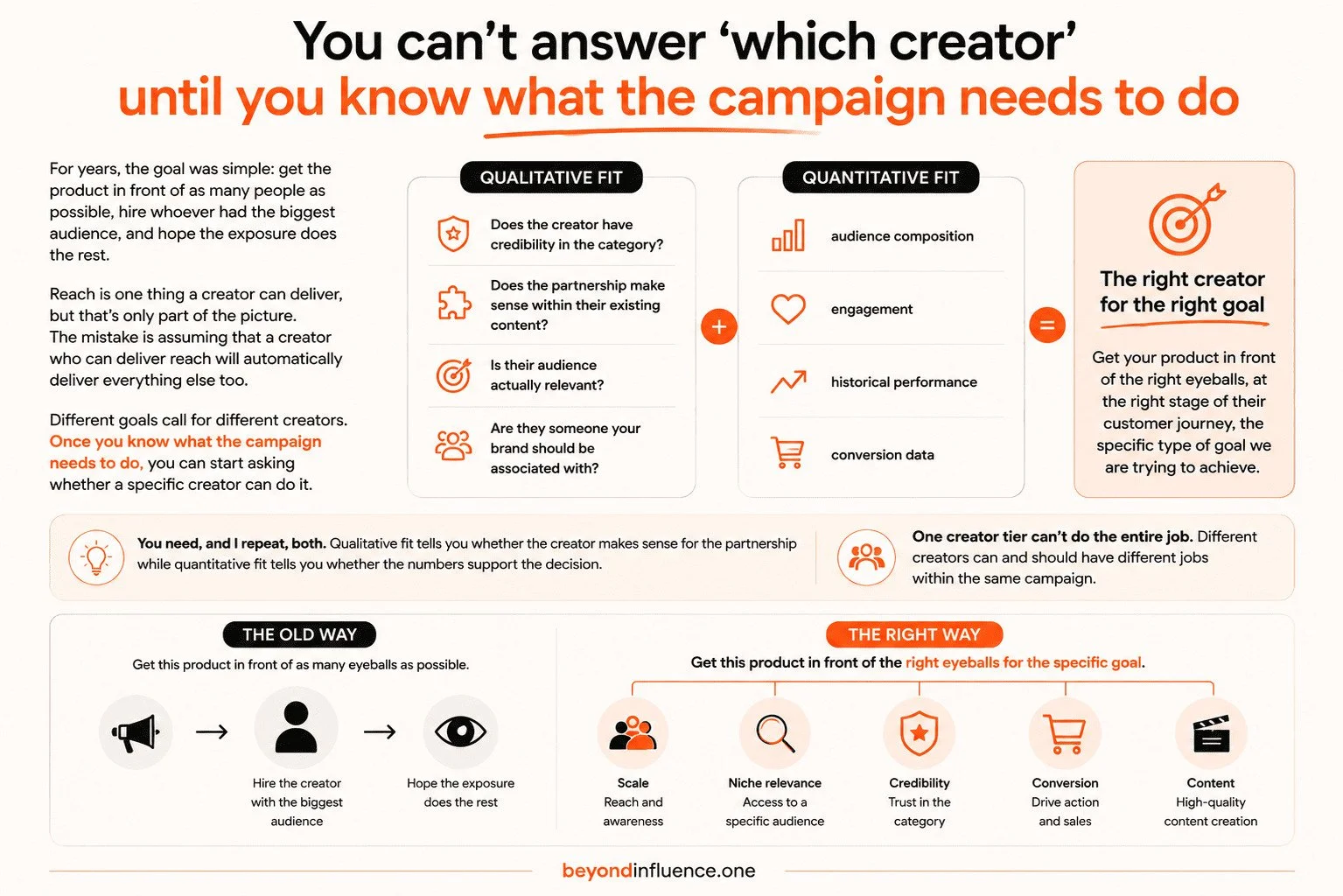
For years, the goal was simple: get the product in front of as many people as possible, hire whoever had the biggest audience, and hope the exposure does the rest.
Reach is one thing a creator can deliver, but that’s only part of the picture. If that is genuinely your goal, fine. Hire for it. The mistake is assuming that a creator who can deliver reach will automatically deliver everything else too.
If you’re looking to build credibility, that calls for a different creator than the one who will drive awareness. Same goes for generating consideration, or closing sales. Once you know what the campaign needs to do, you can start asking whether a specific creator can do it.
Start with qualitative fit:
Does the creator have credibility in the category?
Does the partnership make sense within their existing content?
Is their audience relevant?
Are they someone your brand should be associated with?
Then comes quantitative fit:
audience composition
engagement
historical performance
conversion data
You need, and I repeat, both. Qualitative fit tells you whether the creator makes sense for the partnership, while quantitative fit tells you whether the numbers support the decision.
And stop making one creator tier do the entire job. Micro isn't automatically better than macro, and one macro creator isn't automatically the answer. Different creators can and should have different jobs within the same campaign. One might give you scale, another niche relevance, another credibility, another conversion, and another might simply be exceptionally good at producing the content you need.
Getting your product in front of as many eyeballs as possible shouldn’t be the goal anymore. What matters is the right eyeballs, at the right stage of the customer journey, for whatever the campaign is trying to do. Raw reach comes second.
Influencer stopped being one job
"Just hire an influencer to do this post" used to mean something narrower than it does now.
✓ Feed looks fine
✓ Follower count is impressive
✓ Reach numbers are impressive
Hired.
But what are you hiring them to do?
"Influencer" has become a much broader category. A creator might be worth hiring because they reach a niche audience, because people trust their opinion, because they know a category inside out, because they're exceptionally good at creating content, or because they can drive people to buy.
Those aren't the same job.
Not only do we have different influencer tiers, but also different types of content: IGC, EGC, UGC. Do you want employee generated content, do you need content for ads, email or landing pages, or do you need this micro influencer to bring you as many sales as possible? That question changes who you hire, and it's not the same person for every job.
If your goal is awareness, you might put more of your budget into macro and mid-tier creators to build scale, while using micro and nano creators to reach more targeted audiences. If you're focused on credibility or consideration, you might shift more of the mix towards creators with strong category authority and highly engaged communities. If you're focused on conversion, you might prioritize creators with a proven history of driving sales rather than simply looking at their reach.
There's no formula that says 5 macro plus 20 micro plus 50 nano is the right mix. Your creator mix should reflect what you're trying to achieve, and one creator can't give you everything. They shouldn't have to. The same logic applies to deliverables.
I know what you're thinking: Jeanette, why are you making this more difficult than it has to be? But if someone's carousels consistently drive more engagement, why are you asking them for a Reel? If someone's great at voiceovers, use that. Yes, it's extra work matching the format to the creator instead of the other way around. It also makes a real difference.
Hiring a creator to do a social post is only a part of the picture now
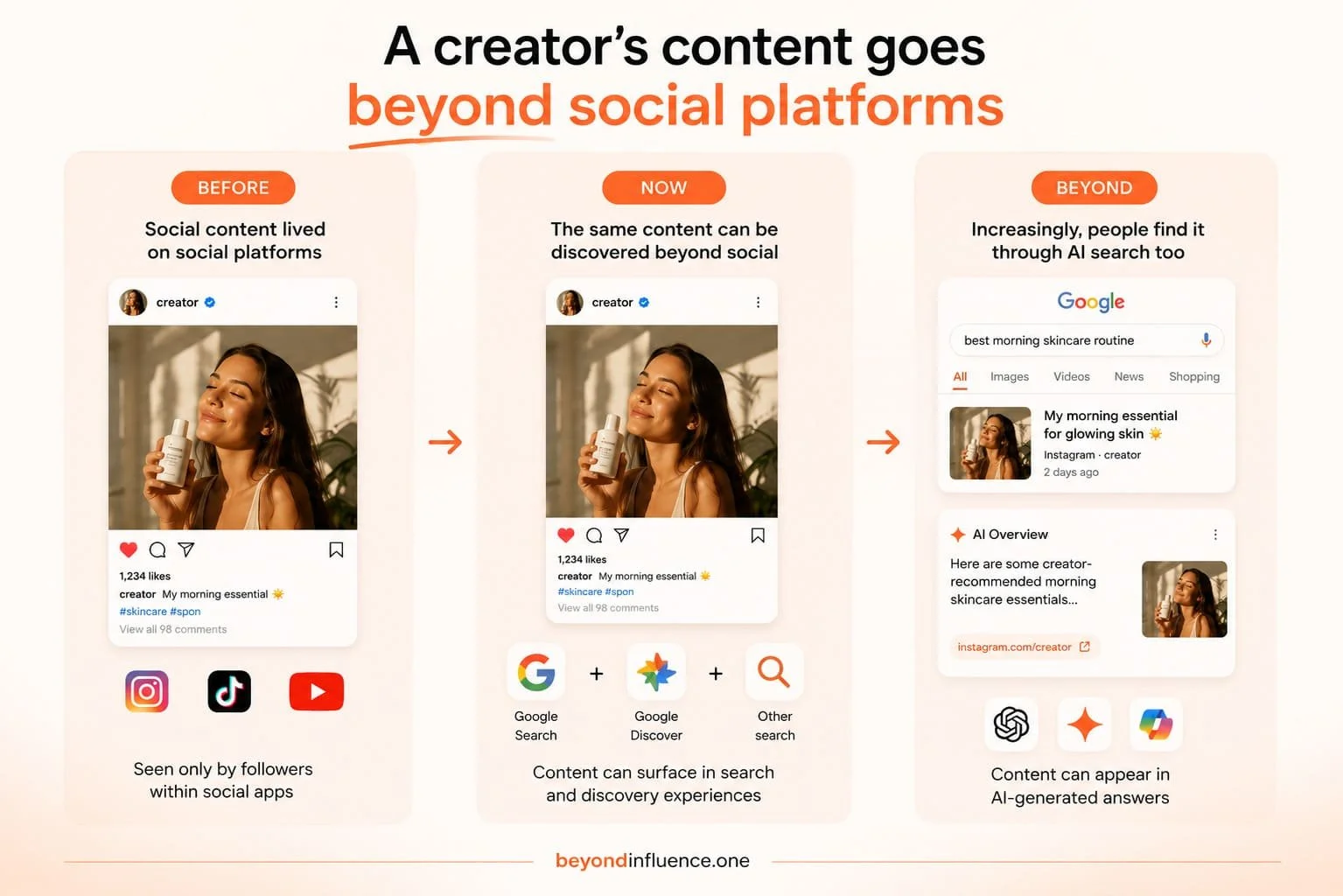
You might hire a creator to post on Instagram, TikTok or YouTube. In 2026, that's not necessarily where someone will discover that content. The same piece can show up in Google Search and Discover, and increasingly, people can encounter it through AI search.
I hear you: “I simply need this anti-age serum on Instagram for our launch”. Of course you do, and that is valid. But the lifetime value of the content has changed, and it's worth looking at what happens to it beyond the socials.
That doesn't mean every post will rank on Google or become an evergreen traffic machine, and it doesn't have to. Knowing the potential puts you one step closer to a strategy that pays off in more than one way. The recent Google Search Console update, which lets you connect X, Instagram, YouTube, and TikTok, shows you the searches already bringing people to your social posts. Those queries tell you what people are trying to find, and they're a better starting point for creator content than a meeting full of guesses. If people are already searching for retinol alternatives, that's worth knowing before you plan your next batch of content.
The creator still makes the social post. A get-ready-with-me Reel or a bedtime routine video might perform well there, but that's not the only place it can perform anymore. It's a search asset too.
You should be thinking about where else it can surface and how much you can get out of content you're already paying to create. That changes how you brief the creator.
Give creators more than a product and a due date
“Can’t we go back to the easy version of influencer marketing?” you might ask.
It definitely was simpler before: you needed an Instagram post, so you asked for an Instagram post. Even that has become more complicated, because social SEO has become a real part of getting surfaced in search results. Instagram itself has talked about how much captions matter for this.
That means telling creators posting carousels to caption each slide, giving them the keywords to include, and reminding them about alt text and disclosure.
There’s also AEO (answer engine optimization). Knowing which creators to work with also changes your odds of showing up in LLM answers. In practice, that can mean choosing YouTubers over TikTokers for that campaign.
Reach and impressions stopped being enough
Measuring ROI has always been hard, so many people in the industry defaulted to easy numbers: reach, impressions, likes. They never told you much, but they were something. It's about time we stopped pretending they're enough.
Measurement is something you need to agree on before you launch a campaign and it is something that needs to be happening constantly.
What you need to focus on now are the numbers that tell you something.
If your goal was sales, the question is: How many sales can we attribute to this particular influencer campaign, and how much ROI did we achieve?
That means shifting from: views and impressions (unless your goal is awareness) to CPA, purchases, sign-ups, qualified leads. All of this requires setting up unique promo codes, affiliate links, and UTM parameters, and sharing them with influencers before the campaign starts.
And always, always, measuring what the spend produced.
Influencer marketing is a relationship business
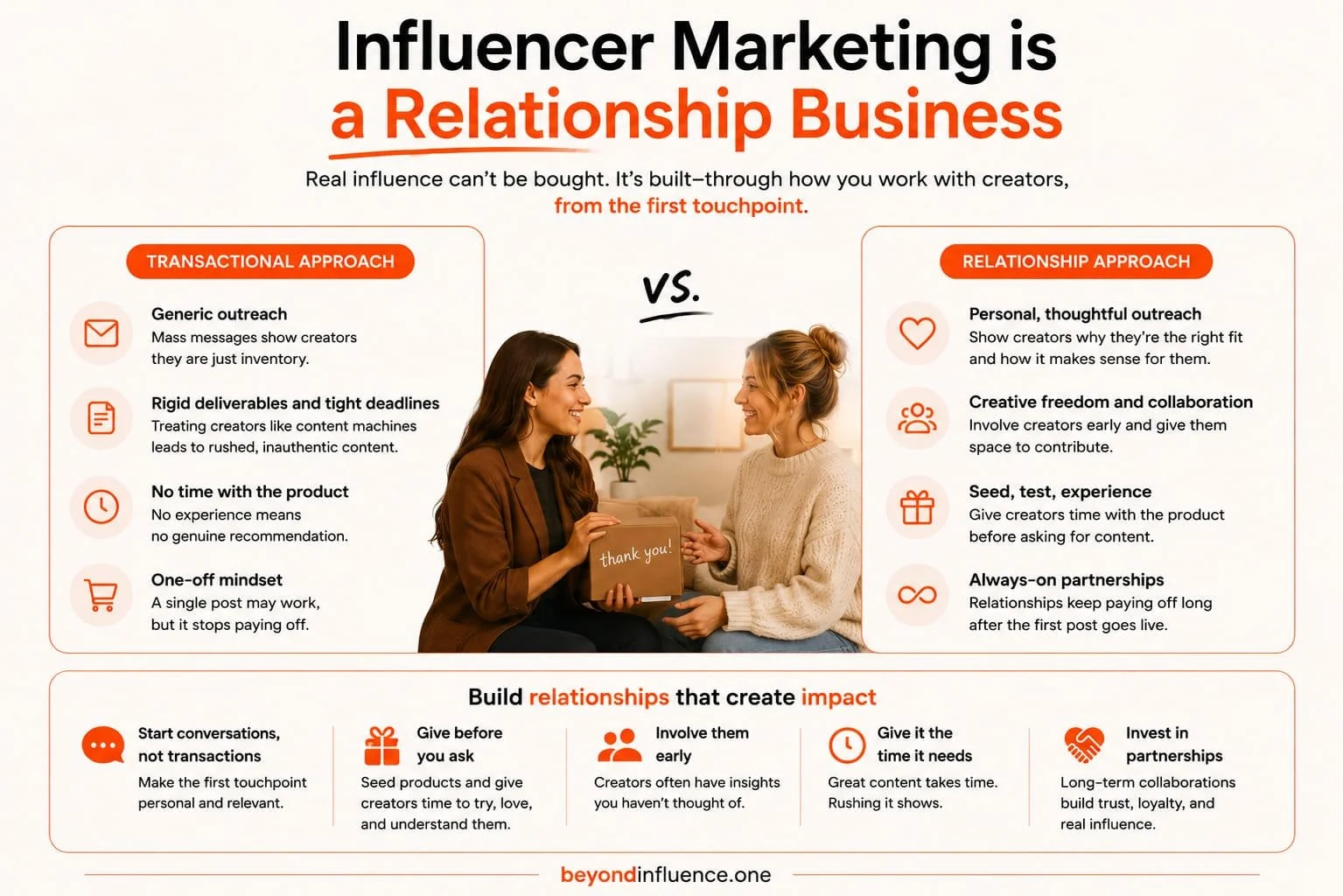
Your relationship with a creator starts with the first outreach and shapes how they feel about working with your brand from then on. A generic, transactional message gets a generic, transactional collaboration back. Send every creator the same offer and the same deliverables, and you've told them exactly what they are to you: inventory. Beyond that, you need to realize that influencer marketing isn’t only about influencers, but also about their influence and the relationships they have with their audience. That means changing what you give creators to work with so you can get as genuine content as possible, especially now that the audience has become far more selective. That can mean seeding products before a campaign begins, giving creators time with them, involving them earlier when they have something useful to contribute, or accepting that not every collaboration needs to produce a post immediately.
"But we need this post live by yesterday" isn't an argument for rushing the collaboration. If the timing doesn't leave room for the creator to experience the product, maybe that particular opportunity isn't the right one.A single paid post may be the right decision at the moment and it definitely has its perks, but brands need to invest in always-on partnerships that keep paying off. And the keyword here is: partnerships.
Reach, impressions, and followers can be bought. AI-generated content can be mass-produced by the truckload. Everything else got easier to fake, so real influence is what stands out. It has to be built, and whether you succeed depends on how you work with creators, from the first touchpoint.
So, what do you do now?
Many brands will shrug and keep doing things the way they were doing them until now. And that’s their choice, after all.
But if you want influencer marketing to do more than generate a pile of posts and impressions, your current strategy needs a hard look.
Think beyond the post itself. Who you're working with, what you're asking them to create, what happens to that content afterward, and what you want it to achieve all need to be connected.
The old way of doing influencer marketing isn't necessarily wrong; it's just not enough anymore.