Influencer Marketing is not the silver bullet for your problems in marketing
Scroll Instagram for a few minutes and there's a good chance the whole creator market somehow shows up in your feed: a UGC ad selling you the hot new portable blender, an employee taking you behind the scenes, and an influencer promoting protein pancakes from a kitchen so tidy you'd wonder if anyone lives there at all.
There's no shortage of people who can make content for you. The question is: should you do the whole influencer marketing shebang, use all the different kinds of content all the time, and when is a lot too much? After more than 15 years in this industry, I have found: doing less, on purpose, will get you further than doing more with no clear idea why.
EGC vs IGC vs UGC: Who should be creating your content?
The term “Creator" has turned into an umbrella term over the years. There are different types of creators you can get content from, which is important because you're not hiring all of them to do the same job.
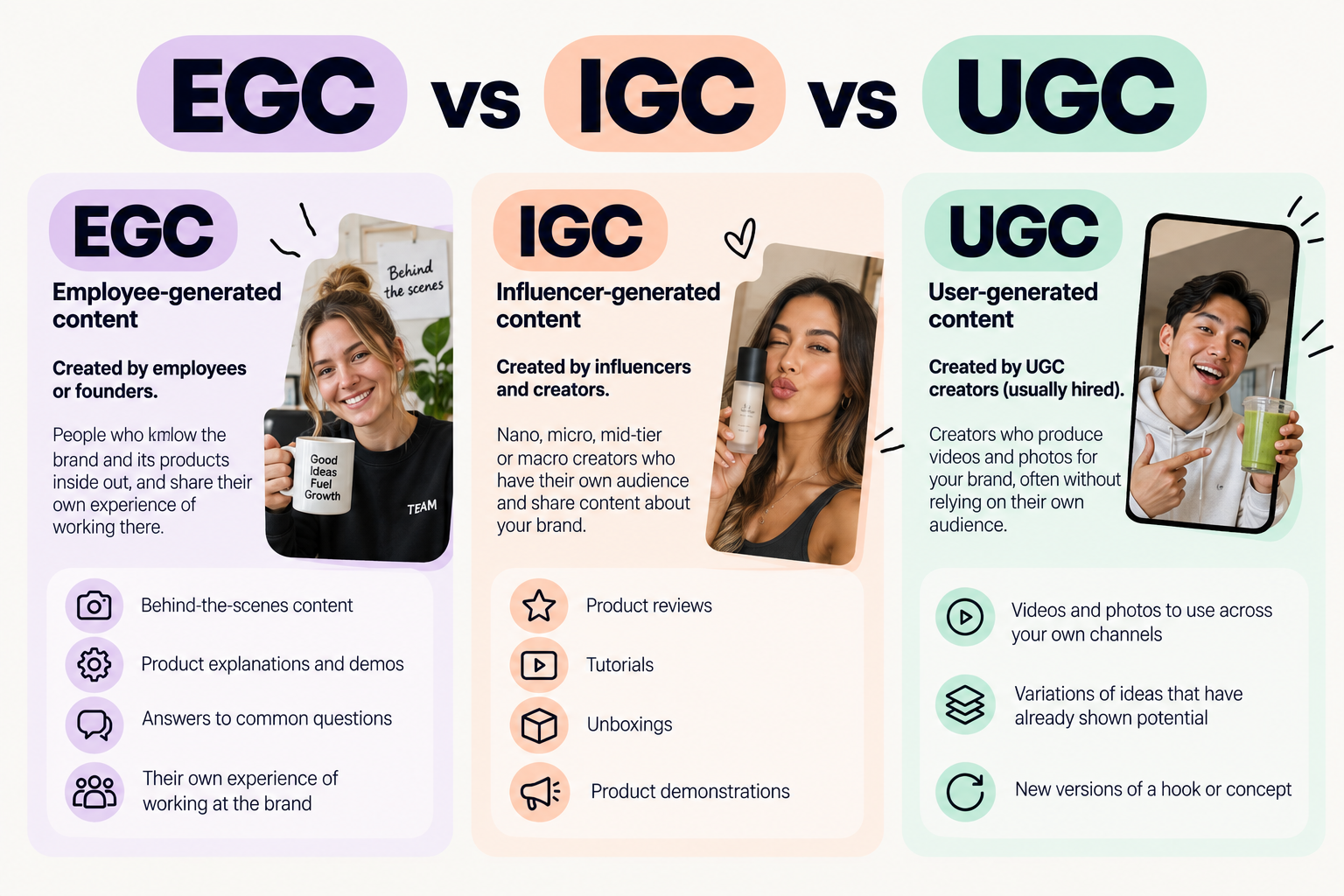
Employee-generated content (EGC) comes from employees or founders, the people who know the brand and its products inside out. They can take people behind the scenes, show how a product works, answer questions, and talk about the brand from their own experience of working there.
Sprout Social's 2026 Influencer Marketing Report found that 40% of consumers discover new products through employee content at least once a month.
Many brands are looking inside their own companies for their next creators. Marks & Spencer nailed it with Kathryn Turner, Director of Product Development at M&S Food, who we talked about in this article. Is there one already on your payroll?
Influencer-generated content (IGC) comes from a much wider pool: nano, micro, mid-tier and macro creators. That content can take many forms: product reviews, tutorials, unboxings, and product demonstrations. Influencers typically post to their own channels, so you're getting both the content and the distribution.
User-generated content (UGC) comes from UGC creators and is useful when you need the videos and photos themselves to run across your own paid social, landing pages, website, and other channels.
UGC creators are handy for producing variations of ideas that have already shown potential. Perhaps there's an influencer post that performed well, and you want more versions of the same idea, or a hook you want to recreate in another video.
So, in simple terms: EGC gives you the employee perspective, IGC gives you the creator perspective plus distribution, and UGC gives you content you can use across your own channels. Which one you need depends on what you want the content to achieve and where you’ll use it.
You may not need all 3 right now, and in 6 months you might need every one of them. A creator program is allowed to look different at each stage.
Pick the right mix of creators for your objective
A product launch usually calls for IGC from bigger creators for reach at scale, then smaller creators for credibility and niche expertise, with UGC and partnership ads layered in.
If you want to run ads only, IGC and UGC can both work, but it matters whether you want them from the brand's account or the influencer's handle.
For advocacy, pair EGC with IGC. Employees talk about the brand from the inside, creators bring their own experience and their own audience, and together you get people vouching for the brand from 2 different positions.
Hoping for that one post or that one creator who finally makes you go viral? Good luck with that.
On a tight budget, take it in baby steps. Start with the people inside your company, then test nano and micro creators through seeding before you commit to bigger fees.
Listen to creators, I beg of you.
Sometimes it's hard to get out of the way, I know. It's your brand, your baby, and you want every piece of content that goes out on social media to look exactly the way you pictured it.
Sorry to burst your bubble, but that probably won't happen, ever. Even with a spotless creator roster, some customers can still film a 45-second reel about how the T-shirt they bought from you doesn't fit them the way it fits the model, who's 20 cm taller and built differently.
Now, creators still need direction and input. Share your campaign objective so they understand where YOU are coming from. This is the mandatory information, the claims they can and can't make, what you need from them and by when, and the disclosure rules, then leave the how to them. I call that structured freedom.
Give every creator the same 2 script variations, and the results will look a lot like the ad you scrolled past in bed last night without registering it. You'll also miss what the creators would have brought, maybe a hook you hadn't thought of or a better way of explaining the product, and one of those might be the clear winner.
The brand might know the product better than anyone, but the creator knows what makes their audience stop scrolling, so let each side handle the half it knows best.
Pay attention to what your creator program is telling you
Many brands still decide where they want to be based on what everyone else is doing.
"Everyone is on TikTok." Okay. Is your audience there? If not, what's the point?
I get it. Some guy you know cracked TikTok Shop and now won't stop telling everyone how he did it, or a guru told you TikTok is where you need to be.
Maybe it will work for you, and if it does, great. Without a deliberate plan for where the money goes, though, there may not be much budget left by the time you find out.
In practice, that means tracking what's working for your program and what isn't, measuring it, and adjusting. If your creators' YouTube tutorials keep doing more for your objective than your TikTok videos, that's a clear reason to put more into YouTube.
Every brand has its own audience, objectives, products and voice, so even if you look a lot like a competitor, something about your program will be yours alone.
If you’re running campaigns and still don't know what they delivered, do yourself a favor and hire someone who can measure it. I honestly don’t care if it’s me. Just hire somebody who can do it. Take the advice now or learn it the hard way. And if you'd rather start with us, the Influencer Marketing Health Check is built for this.
Put paid spend behind what already works
Setting the amplification budget before any content has proved itself organically is a bet. If your budget is unlimited, go for it. Most brands don't have that luxury.
At beyondINFLUENCE, we put paid spend behind creator content that has already shown organic traction, and only where it fits the campaign objective.
We typically run those ads from the creator's own handle. We've seen enough of a difference against brand-handle ads that it's how we prefer to run them.
Good to know we're not imagining it. Forbes reported on an analysis by Agentio of $130 million in Meta Partnership Ads spend, covering 65,000 ads from 137 brands. Ads carrying the creator's handle got 19% more clicks, converted 10% better and cost 5% less per customer than licensed UGC run from the brand's own account.
Try it and see what happens. You can thank me later.
We also settle paid usage rights in the creator contract up front, so a post that proves itself can run as an ad the same week. That saves you a lot of back-and-forth with the creator.
Keep your best creators close
Some creators will work with you once and end up as a row in a Google Sheet you'll never open again. That's fine.
Creators are people, and that's easy to forget when you spend your days in a Google Sheet full of Instagram handles and posting dates. Making them feel seen is how you build relationships that last.
Here’s what I mean:
If you run an affiliate program, give your strongest performers a reason to keep creating content, and reward them with a higher commission. Offer 5%, make affiliates sweat to sell 100 units and then pay them peanuts, and they won't stay motivated for long.
Set up a private Facebook group, an Instagram broadcast channel or even a Discord server for program updates and sneak peeks at your next launches.
A monthly group call works too, with your influencer manager there to listen to their feedback and ideas. You'd be surprised how much they have to say about improving the product, and how many questions their audiences are asking about it.
"But Jeanette, I don't have money for this." I hear you. A handwritten note tucked into your next PR package costs you a pen and 5 minutes.
The goal is to keep your strongest creators close and make them an ongoing part of your program. Some are fine as rows in a Google Sheet, but if every one of them is, your program is missing out.
Your creator program is supposed to change
Bad news first: the mix that works today might not work 6 months from now. Platforms change, new formats show up, ad performance shifts, and the creator who was perfect for you last year may not be right for the next campaign. The good news is that no mix has to be permanent.
So review all of it regularly: who's creating for you, what they're making, where it's working and where it isn't, and where your paid spend is going.
Instead of doing everything, your creator program needs to do what serves your objective right now, and change when the objective does. That sounds obvious enough, and it's surprisingly easy to forget once the campaign calendar is full.
-
EGC comes from employees and founders, who can show the brand from the inside. IGC comes from nano, micro, mid-tier and macro creators who post to their own channels, so you get the content and the distribution. UGC gives you videos and photos to run on your own channels, like paid social, landing pages and your website.
-
A launch usually calls for bigger creators for reach at scale, then smaller creators for credibility and niche expertise. UGC and partnership ads get layered in.
-
Start with the people inside your company. Then test nano and micro creators through seeding before you commit to bigger fees.
-
Give creators the campaign objective, the mandatory information, the claims they can and can't make, what you need and by when, and the disclosure rules. Leave the how to them, because they know what makes their audience stop scrolling.
-
At beyondINFLUENCE, we prefer the creator's handle. Forbes reported on an Agentio analysis of $130 million in Meta Partnership Ads spend, where ads carrying the creator's handle got 19% more clicks, converted 10% better and cost 5% less per customer than licensed UGC run from the brand's own account.
-
Put paid spend behind creator content once it has shown organic traction and fits the campaign objective. Settle paid usage rights in the creator contract up front, so a post that proves itself can run as an ad the same week.
-
Reward your top affiliate performers with a higher commission. Give creators a place to hear from you first, like a private Facebook group, an Instagram broadcast channel or a Discord server for program updates and sneak peeks. A monthly group call with your influencer manager works too, and creators tend to have plenty to say about the product and what their audiences ask about it.