12 Influencer Marketing Terms Brands Keep Mixing Up
I've had clients ask us to put usage rights in a contract, and 10 minutes into the conversation it turned out they wanted exclusivity too. We caught it early. If you don't, you find out when the creator you paid posts for a competitor 3 days before your own launch.
Most influencer marketing terms sound close enough to swap, but each one decides something different in your contract, your ads, your legal exposure or your report. Our industry made this worse by using these words loosely in pitches and decks for years, and I include myself in that.
These 6 pairs cause the most expensive mix-ups in the programs we run. If you'd like someone to check your current contracts and reporting against them, that's exactly what our Influencer Marketing Health Check is for.
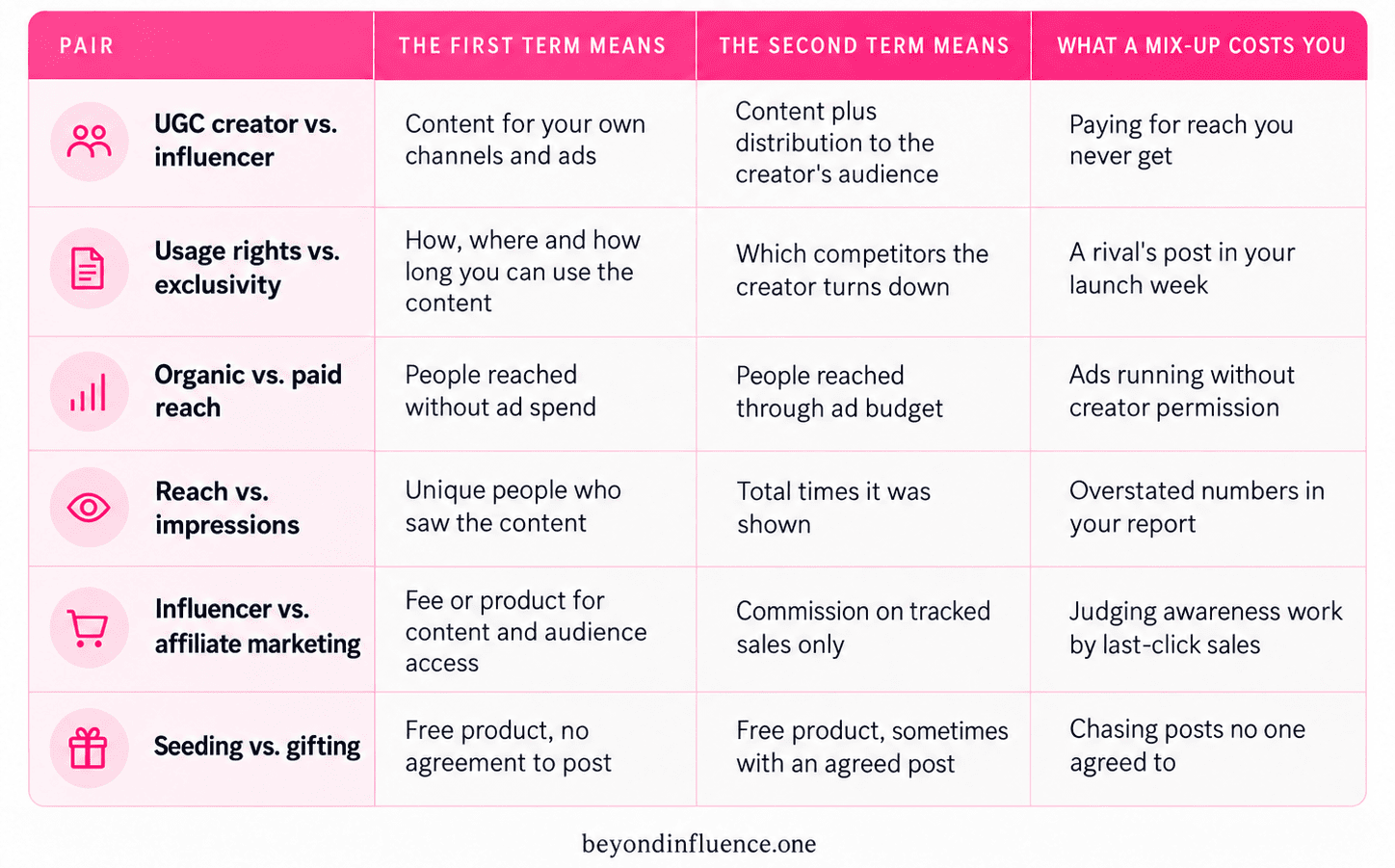
The 12 terms at a glance
What's the difference between a UGC creator and an influencer?
A UGC creator makes content for your own channels and ads. An influencer also posts it to an audience that already follows them.
A UGC creator produces photos and videos for you to run on your own social accounts, product pages, emails and paid ads. Their follower count barely matters, because the content rarely goes out on their own profile. You're buying the asset, and you usually get more say over the creative, so a script or a shot list is normal.
An influencer creates content too, but it goes out on their channels to people who already trust them. You're paying for the content and the distribution, which is why the tier, from nano creators up to mega accounts, moves the price so much.
Plenty of creators do both, and we've written separately about how to choose between UGC creators and influencers. What decides the role is what you're paying for.
We plan UGC as its own layer in a campaign, next to awareness and conversion, because the rights, the pricing and the KPIs all work differently. And UGC is only useful once the rights for paid placements are in the contract from day one.
Do usage rights include exclusivity?
No. Usage rights cover how, where and how long you can use the content. Exclusivity is a separate term about which competitors the creator turns down.
This is the pair that costs brands the most, I think. A lot of brands still assume a paid Reel is theirs to use any way they like, and if the usage isn't written down, you don't have it. It doesn't matter whether the Reel cost $80 or $800.
A usage clause should name the channels (organic reposts, paid ads, website, email, out-of-home), the markets and the duration. Territory is the line that catches multi-market brands, because rights cleared for Germany don't automatically cover the same ad running in Austria and Switzerland. Under German copyright law the creator stays the author and what you buy is a license, so a broad buyout holds up best when the rights are named clearly and limited by time or territory.
Now, in 2026 this clause needs one more line, and it's about AI. Can you cut the footage into new edits, feed it into an AI tool, or generate new content with the creator's face or voice? If the contract doesn't say so, assume you can't.
That's the ground the TrueRights and EIMA Code of Conduct on creator IP and AI covers, and I'm genuinely glad these clauses are becoming standard in creator contracts.
With exclusivity, the creator agrees not to work with competing brands for a set period, usually a window before and after your posts go live. Category exclusivity is the common version: a skincare creator skips other skincare brands for 30 days, and promoting protein pancakes is still fine.
Name the competitors in the contract. "Skincare" leaves room to argue about whether a sunscreen or a collagen supplement counts, and you don't want that argument in your launch week.
Full exclusivity, where the creator runs no sponsored content at all for a period, is rare and expensive. Either version is paid on top of the content fee and any usage fee, because you're paying the creator to say no to work.
What's the difference between organic and paid reach in influencer marketing?
Organic reach is who sees a creator's post without ad spend. Paid reach comes from budget behind it, run from your account or the creator's.
Organic reach comes from the feed, the creator's profile, Explore, TikTok's For You page and Stories reshares, and the algorithm decides how far it goes. Sometimes that works in your favor, and sometimes, honestly, it's a pain.
Paid reach means putting ad budget behind the content. You can run it from your brand account, or from the creator's handle as a partnership ad on Meta or a Spark Ad on TikTok. We do the second a lot at beyondINFLUENCE, usually when a post has already done well organically and we want more of the right people to see it.
There's a third term hiding in here that gets folded into usage rights: ad access. To run ads through a creator's handle, the creator grants permission on the platform itself, and on TikTok that's an authorization code with an expiry date.
That permission is separate from the usage clause in your contract. You need both, and the contract should say how long the creator keeps the access open.
Paid gives you targeting by location and interests, retargeting of people who've visited your site, and faster results. Managed badly, it turns into a budget leak quickly. I'd plan every campaign with both, because the posts that do well organically are usually the ones worth paying to push.
What's the difference between reach and impressions?
Reach is how many people saw your content, impressions are how often it was shown, and impressions divided by reach gives you frequency.
If one person sees a post 5 times, that's 1 in reach and 5 in impressions. You know this already. What trips up reporting is that the platforms changed the vocabulary.
In April 2025, Instagram replaced impressions with views in its insights and its API, and views count replays. TikTok reports video views, and your influencer platform may still pull impressions from older data. So one campaign report can mix 3 different counts under similar names, and the totals stop making sense the moment someone compares them.
The number I'd look at next is frequency: impressions divided by reach. At 1.2, you mostly reached new people. If it climbs to 6, the same people saw you again and again, which can be exactly right for recall during a launch and a sign of a tired audience by week 3 of an always-on program.
Reach and impressions are where an awareness report starts. Add frequency, and a brand lift study where the budget allows it, because clicks and views only show part of what awareness work does.
How is influencer marketing different from affiliate marketing?
Influencer marketing pays for content and audience access toward any funnel goal, while affiliate marketing pays commission only on tracked sales.
Influencer marketing pays creators a fee or product for content and access to their audience, and a campaign can aim at awareness, consideration or sales. Affiliate partners earn a commission on whatever sells through their link or code, and if nothing sells, you don't pay. Coupon sites and online publishers can be affiliates too.
Affiliate looks easier to measure because every sale has a name on it. In practice it's shakier than that. Discount codes leak onto coupon sites, and when someone who has already decided to buy goes looking for a code, the coupon site takes the last-click credit for a sale the creator talked them into.
Influencer work is harder to attribute because it runs across the whole funnel. Someone sees your product in a creator's video in April, keeps seeing it, and buys in June, after the campaign report has gone out.
The way I see it, the two work best together. A creator gets someone interested, the affiliate link proves they bought, and suddenly your finance team has a number it actually trusts. TikTok Shop makes the hybrid easy to see: creators tag products, earn commission on every sale, and plenty of them take paid brand deals too.
One legal point for Germany: brands are liable for what their affiliate partners do within the program, a principle the Federal Court of Justice (BGH) set in its 2009 "Partnerprogramm" ruling. An affiliate who posts without proper labeling is your problem as well.
What's the difference between gifting and seeding?
Seeding sends free product with no agreement to post. Gifting can mean the same thing, or a deal where the creator agrees to post for product.
Seeding means sending product to a creator who fits and letting them decide. If they love it, they share it because they want to. If they don't, it ends up in a drawer next to everything else brands sent them last month, and you have to be okay with that.
Gifting is the murky one, because people use the word for 2 things: the same no-strings package, or a gifted collaboration where the creator agrees upfront to post in exchange for the product. The easiest test is that seeding never asks for a post, and gifting might.
So say what you expect before anything gets packed. When we run gifting, we position it as the first step toward an ambassador program, and the most active creators get considered first for the next steps. Creators understand what the relationship could become, and no one gets chased for a post they never agreed to.
Free product still counts when it comes to labeling. In Germany, a post about a gifted product generally has to be marked as advertising, and under competition law (UWG) the brand can receive a cease-and-desist letter for a creator's unlabeled post.
In the US, the FTC treats free product as a material connection that has to be disclosed. That applies to seeded product too, the moment a creator decides to post about it.
What happens when a campaign mixes up all 12 terms?
You chase seeded creators for posts, run Reels as ads without rights, overstate reach in the report and watch a paid creator promote a rival.
Picture it. You seed 50 creators and then chase all of them for posts. The ones who did post find their Reels running as ads with no usage rights and no ad access in place.
Your report says 2 million people saw the campaign, when 2 million was views, replays included. If someone on your paid team catches it before the report goes out, you got lucky.
Meanwhile, the creator you paid $1,000 posts about a competitor's pore-minimizing serum the day before your launch, because exclusivity never came up. Their followers now have 2 serums to choose from, and yours showed up second.
Each of those mistakes comes down to a contract line or a report definition that never got written down. If you'd like a second pair of eyes on yours, our Influencer Marketing Health Check goes through these terms with your team, using your actual contracts and reports.
Let's influence.
Frequently Asked Questions
-
A UGC creator makes content for a brand to use on its own channels or in ads, so you pay for the content alone. An influencer posts to their own audience, so you pay for the content and the people who follow them.
-
Usage rights set where and for how long a brand can use a creator’s content. Exclusivity stops the creator working with competing brands for a set period. They’re separate terms, so one never includes the other, and each is usually priced on top of the content fee.
-
Reach is the number of people who saw a piece of content. Impressions are the total number of times it was shown. If one person sees a post 5 times, that counts once in reach and 5 times in impressions.
-
Organic reach is the number of people a post reaches without any ad spend. Paid reach comes from putting ad budget behind content.
-
Both mean sending creators free product. Seeding comes with no obligation to post. Gifting can mean the same no-strings package, or a gifted collaboration where the creator agrees upfront to make content in exchange for the product.