Employee-Generated Content in Action: What Marks & Spencer Got Right About Influencer Marketing
A lot of brands have a type when they hire influencers. Big following first, ideally big enough to fill a stadium (or a few), plus a feed that looks like a Pinterest board. And the creator is almost always in their 20s, as if the algorithm checks your birth certificate before letting you onto the For You page.
Kathryn Turner is a pretty good argument for throwing that stereotype out altogether. She has no Linktree with a media kit in her bio, or anything else that suggests she set out to become an influencer. Yet she's the one racking up views for Marks & Spencer Food.
For any brand that still filters its creator shortlist by age, that should sting a little.
Who is Kathryn Turner at M&S Food?
Kathryn Turner is Director of Product Development at M&S Food and has spent more than 25 years developing its products.
She started posting on TikTok mid-May 2026 and reached close to 50,000 followers within a month. She now has more than 246,000 followers on TikTok and more than 161,000 on Instagram.
The videos take followers behind the scenes of the products and the brand, such as Foodhall "hidden gems”, bakery favorites, the 80s chocolate bars M&S brought back, and farm visits showing where the ingredients come from.
And somehow, people can’t seem to get enough of it. The comments are where it gets fun: people say they'd buy oxygen from her, and under a video about the M&S chocolate range, one follower blames her for a waistline that "will not survive this winter."
Whatever M&S puts in those products, Kathryn has people eating out of her hand.
Age, influence and spending power
Gen X has been the world's highest-spending generation since 2021. According to NIQ and World Data Lab, Gen X had $15.2 trillion in buying power in 2025 and outspent Gen Z by 40%.
Food is a big chunk of that: Gen X spending on food and non-alcoholic drinks is projected to rise by $507 billion between 2025 and 2030. (Source: https://nielseniq.com/global/en/insights/report/2025/the-x-factor/)
We're all scrolling, including the people with mortgages, school runs and a completely unreasonable number of emails to answer. Shockingly, we have phones too.
Social media and influencer marketing still get talked about as if they belong to the young. Brands that plan that way overlook the people with the most spending power.
If a 21-year-old beauty influencer is talking about wrinkles, I'm out, sorry. Give me someone who has wrinkles and can convince me to spend $70 on a night cream, because apparently this is the week I finally smooth out my wrinkles.
BUT when I want to know what a piece of slang means, I turn to a Gen Z TikTok to explain it to me like I'm 5. Age matters when it's part of what someone knows, and that works in both directions.
Lily Comba, founder and CEO of Superbloom, told Digiday in September that older creators keep their followers as customers for longer and can charge higher fees, and she puts it down to how safe and believable their audiences find them.
Brands need to drop the assumption that influence comes with an age limit. What makes me listen is whether someone knows what they're talking about, and when the topic is what's worth buying at M&S, few people know more than the person who's spent 20+ years developing its products.
Where does Kathryn's authority come from?
Her authority comes from more than 20 years developing products she’s talking about. The follower count came later, and honestly, good for her.
When she picks up an M&S chocolate bar her team developed, she knows what's in it and where the ingredients come from, because she was the one who signed it off.
That knowledge shows on camera. She talks about the products with the detail and ease of someone describing her own work, and I think that's why people in the comments say they'd buy oxygen from her.
Typical creators earn their credibility by testing products and being straight with their audience about what works. Kathryn's comes from the other end of the process, as the senior professional who decided why a product should exist and how it should be made. That's the kind of knowledge only someone inside the business has.
Both kinds of credibility count, and they matter far more than raw reach in influencer marketing. I'll keep repeating that until it sticks.
People pay attention to someone with something to say and enough personality to make them want to hear it. M&S hit the nail on the head with this move, and they deserve all the credit for it. As for Kathryn's next salary review, it should be a short meeting.
Product knowledge in front of the camera, social media know-how behind it
Plenty of senior people with deep expertise make content for their companies without going viral, so the fair question is what made this one different.
Kathryn herself credited the 20-somethings on her team in a LinkedIn post:
“How do you go from 30 TikTok followers to 101,000, and from almost no Instagram presence to 80,000 followers, all in just eight weeks…
…Listen to the brilliant 20-somethings in your team.”
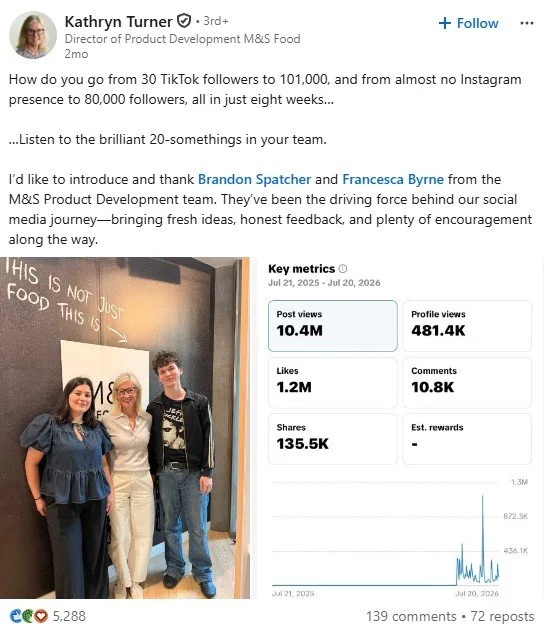
Kathryn brought the authority and decades of product knowledge, and the social team around her brought platform expertise and a different understanding of what works online. Neither side had to be the other. This is what happens when everybody brings what they do best to the table, and it's a good reminder that more often than not, you need a mix of generations to make this work.
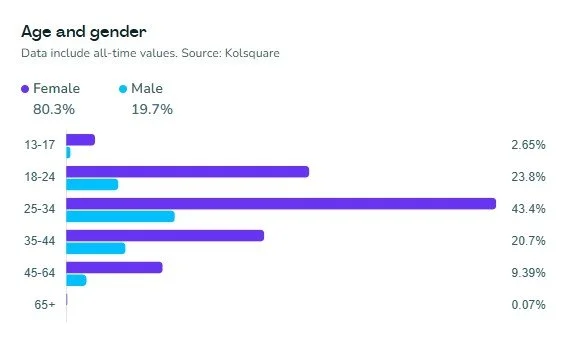
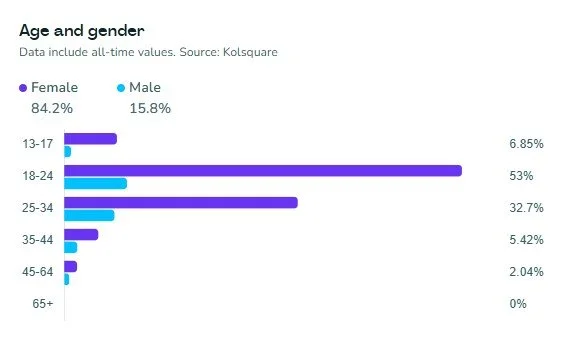
That cross-generational mix shows up in her audience too, which isn't limited to the generation she might be expected to speak to.
Instagram Demographics:
TikTok demographics:
A 20-year-old follower might not be doing the weekly M&S shop tomorrow, but they might be building familiarity with the brand now. They get to know Kathryn and hear the stories behind the products she works on, and maybe they buy now, or years from now when the weekly shop is theirs to do.
That's how influencer marketing works most of the time: few interactions lead straight to a purchase, and familiarity does the slow work. TikTok's biggest age groups are between 18 and 34, so M&S is picking up younger customers where they spend their time.
What can other brands learn from M&S?
Other brands can look for credible voices inside their own business and back them with people who know the platforms, whatever anyone's age.
If you're thinking, "I'm going to hand a phone to Phyllis, who has been at my company for 15 years, and make her the next TikTok star," I'm sure Phyllis is brilliant. Before you put a decision this big on her back, a few things are worth thinking through.
Your next big creator may already work for you. Most companies have people with unusual expertise or a story others want to hear. It might be the founder, a designer, the person who fixes everyone's laptop, or Phyllis.
Age is a poor filter. You need to take a good look at your customers, the products you’re selling, your employee’s credibility and the strength of the connection they can create rather than relying on trends or 22-year-old influencers only.
Let everybody do what they're good at. Kathryn didn't figure out TikTok alone**, and she's the first to say so.** She brought decades of product knowledge, and her younger colleagues brought the social media expertise. Win-win.
There's another interesting part to this. M&S had the option to make Kathryn the face of its own TikTok and Instagram, but the content goes out on Kathryn's own accounts instead. She has an audience there that chose to follow her, and M&S reaches that audience through her. Her content is also generating significantly more engagement than the M&S account.
People want to see people, and other brands have noticed. Starbucks now pays selected baristas to make TikToks and gives them a share of the ad revenue.
Being an expert and being good on camera are two separate skills, though. If EGC (as well as IGC or UGC) is forced, we can all tell. Someone can have the expertise and the camera presence and still be missing a social strategy, and it's harder than it looks from the outside.
The influencer stereotype needs an update
Picture an influencer for a second. What do they look like and what kind of content do they create? You might think of somebody holding a Stanley cup (from a cupboard full of them) and posting a "come get my nails done with me" reel. Chances are you have a handle or two in mind already. I do, and I still enjoy their content.
But brands need a wider definition than that. The next wave of influencers includes senior professionals, business owners, subject-matter experts and employees who never set out to become influencers in the first place.
Influence has no age limit, and it doesn't always come with a media kit. It can come from knowing your subject inside out and having something worth saying.
In this case, it came from a product director with more than two decades of experience and a younger team who know how the platforms work. If M&S had filtered by age or follower count, Kathryn would never have made the shortlist, and the 246,000 people following her on TikTok would be getting their M&S recommendations from someone who knows a lot less about its products.
Frequently Asked Questions
-
Employee-generated content (EGC) is content that a company's own employees create about their work and expertise. In the M&S case, a product director shows how products get developed and where the ingredients come from. Followers chose to follow her, and the brand reaches them through her.
-
Kathryn Turner is Director of Product Development at M&S Food and has spent more than 25 years developing its products. Her TikTok launched in mid-May 2026 and reached close to 50,000 followers within a month. She now has 234,000 followers on TikTok and 152,000 on Instagram.
-
Gen X has been the world's highest-spending generation since 2021. NIQ and World Data Lab put its 2025 buying power at $15.2 trillion, 40% above Gen Z. Its spending on food and non-alcoholic drinks is projected to rise by $507 billion between 2025 and 2030.
-
Starbucks already runs an EGC program, along with many other brands. EGC has never been bigger, largely because people want to see people. Brands can also build on the same idea with influencer-generated content (IGC) and user-generated content (UGC).